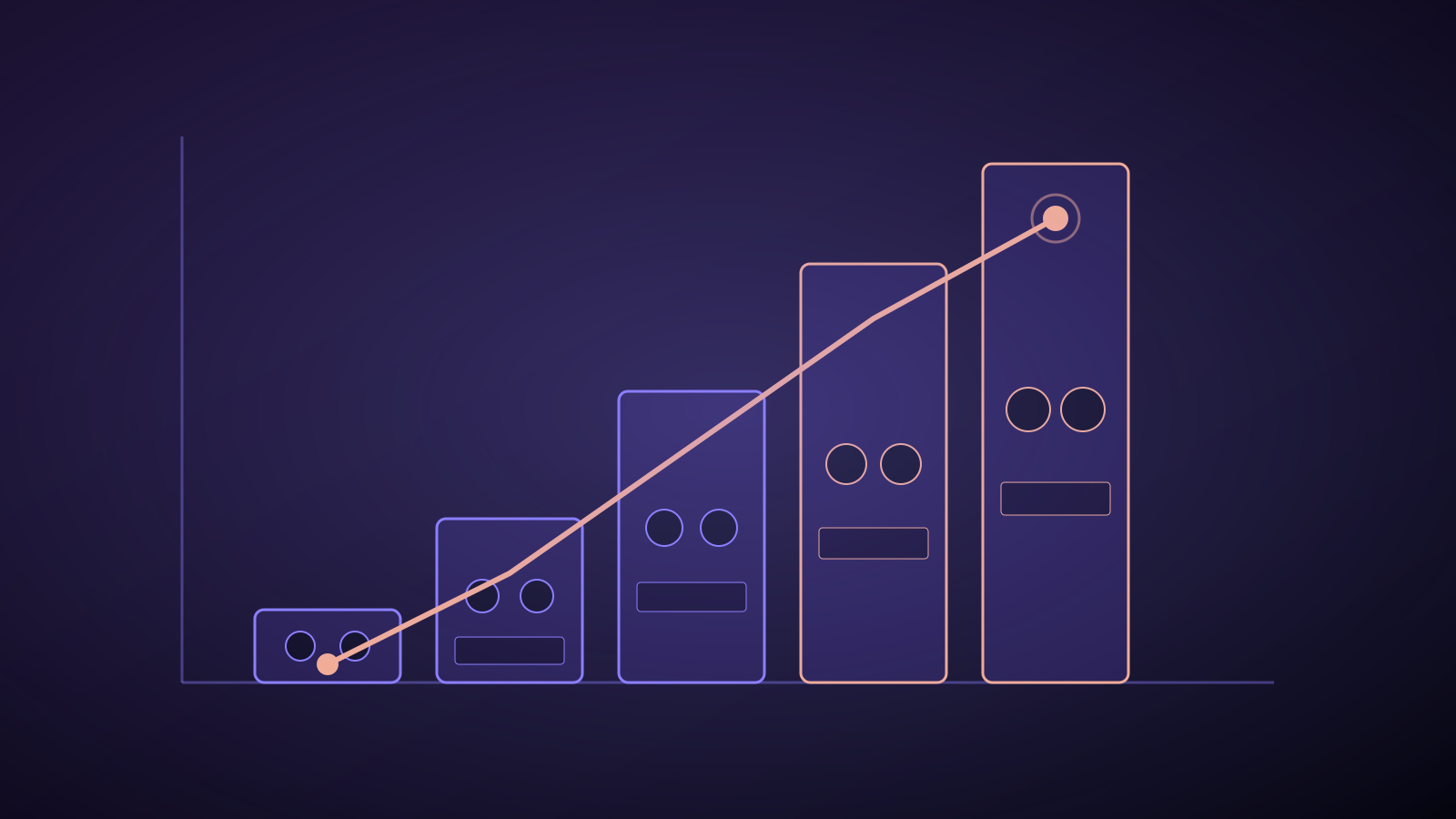
You launch a 24/7 lo-fi stream. You have 0 subscribers. Your concurrent viewer count is 2 — you and your test browser. You will spend the next 90 days in one of two versions of this situation: either you build the infrastructure that lets the algorithm pick you up, or you refresh the analytics page 40 times a day and slowly burn out.
This is the path that actually works. No shortcuts, no hacks, no follow-for-follow. Just the parts of the 24/7 lo-fi playbook that matter most when you have no audience and no signal.
What “growth” means for a 24/7 lo-fi channel
A 24/7 lo-fi channel grows differently from every other type of YouTube channel. On a VOD channel, growth is upload → impression → click → view. On a 24/7 lo-fi channel, growth is impression → click → session length, and session length is the thing everything downstream depends on.
Concretely:
- Subscribers follow session length. A viewer who watches for 45 minutes subscribes at roughly 10x the rate of a viewer who watches for 5 minutes.
- Algorithm visibility follows session length. YouTube’s live-content resurfacing rewrites in the last year explicitly prioritized sessions over clicks.
- Monetization follows session length. Ad breaks stack, memberships convert, Super Chats actually happen.
Everything you do in the first 90 days should be in service of session length. Anything that doesn’t obviously push that number up is a distraction.
The 90-day plan
Day 0 — before you go live
You do not go live until all of the following are true. If one of them isn’t, fix it before you flip the switch. The first 48 hours of a stream set a ceiling on its reach; you only get one.
- Library of 60+ cleared tracks, enough for a 4-hour block with zero repeats. See royalty-free lo-fi tracks for the full licensing path.
- Visual loop at least 2 minutes long, owned or licensed. See lo-fi visuals and loops.
- Cloud streaming infrastructure, not OBS on a laptop. A single outage in the first two weeks kills your algorithmic momentum for months.
- Title and description written for search, with the exact phrases you want to rank for — e.g. “24/7 lo-fi radio for study and sleep” — not clever wordplay.
- A clear thumbnail that reads at thumbnail size, not just at full size.
- Every revenue channel pre-configured: channel memberships, Super Chat, Super Thanks, Patreon link in description, merch shelf placeholder.
- Moderation pre-configured: at least one trusted moderator, a banned-words list, and a link-blocker for obvious spam.
The pre-launch checklist is boring. Skip any item and it compounds into lost subs and watch hours for the entire first month.
Week 1 — the honeymoon that doesn’t exist
There is no honeymoon. Your stream will have 2–10 concurrent viewers. Many of those will be bots. The algorithm is watching to see whether your retention holds against random impressions, not whether your content is good in the abstract.
Your only job in week 1 is don’t go down. Not once. A stream that dies on day 4 and restarts on day 5 is starting from zero again, because YouTube treats the reboot as a new broadcast. Every minute of uptime is a compounding investment.
Secondary week-1 priorities, in order:
- Respond to every single chat message personally. You will never again have this much leverage per interaction.
- Pin a welcome message with a one-sentence description of the channel’s identity and a link to the description for more.
- Seed a Discord server. Five committed Discord members in week 1 are worth a thousand drive-by viewers in month 6.
- Write and schedule Shorts that act as trailers for the stream. Shorts route to the main live feed on most platforms and can be the single biggest source of first-week discovery.
Week 2–4 — the first meaningful numbers
By the end of week 4 you should have a sense of whether the channel has “caught” or not. Signals that it has caught:
- Concurrent viewers are trending up week-over-week, even if slowly.
- Watch time per session is above 15 minutes — a viewer who stays 15 minutes is telling YouTube the content is worth surfacing.
- You have at least one regular — a named viewer who appears more than once.
- At least one day’s worth of impressions came from “Browse” or “Home” surfaces rather than search. Search traffic is fine; browse traffic is evidence the algorithm is pushing you.
If all four are true, the channel has caught. Focus on not breaking it. If only one or two are true, you have room to iterate. If none are true, review the pre-launch checklist — something is broken in the foundation.
Things to actively do in weeks 2–4:
- Schedule mood rotations so viewers in different time zones find what they want. See mood rotations and time zones for the full framework.
- Refresh the title and description weekly with small variations to test which phrasing gets clicked on. YouTube allows this on live broadcasts and it’s one of the cheapest optimization levers available.
- Cross-post a daily Short that teases a specific track or a specific visual moment. Link back to the live stream in every caption.
- Start a Reddit presence in r/Lofi and the study-adjacent subreddits. Post once a week, not promotional — contribute to conversations, and link to your channel only where it genuinely fits.
- Build one piece of off-platform content a week. A TikTok, an Instagram reel, a Twitter/X post. The goal is not the platform itself but the back-link to your stream.
Month 2 — the grind
This is where most new channels quit. The novelty of being live has worn off. The numbers are real but small. The hours spent in the background running a stream for 30 concurrent viewers feel indistinguishable from the hours you spent running it for 2 concurrent viewers.
Keep going. What you do in month 2 is build the compound-interest layer:
- Commit to one daily touchpoint. A reply to every Super Chat, a pinned message update once a day, a schedule post in Discord. Regulars will notice.
- Release 2–3 “named” moments per week. A new mood rotation launches. A guest artist track premieres. A visual Easter egg appears. Give viewers micro-reasons to come back on a specific day.
- Run your first paid experiment. $100 on YouTube Ads in a well-defined promo for a specific demo (18-34 in English-speaking countries, lo-fi and study interests). The goal isn’t to buy subs — it’s to get 500 new impressions from people who wouldn’t have found you otherwise, and to see which of them stay for 20+ minutes.
- Cross-promote with one adjacent channel. Not a lo-fi channel — the audience overlap is too direct. A nature-stream channel, an ambient-music podcast, a study-skills YouTuber. A single cross-mention can add months of organic growth.
Month 3 — the first inflection or the kill decision
By the end of month 3, the numbers should be dramatically different from day 1. A realistic target for a serious channel that followed this plan:
- 100–500 concurrent viewers at peak
- 1,000+ subscribers
- YouTube Partner Program eligibility reached (1,000 subs + 4,000 watch hours in 12 months — watch hours accumulate frighteningly fast on a 24/7 stream)
- At least one viral moment — a Short that crossed 50k views, a Reddit post that hit r/all, a random cross-link from a bigger channel
- A real community — at least 20 named regulars, an active Discord with 50+ members, a chat that keeps talking when you’re not there
If you’re hitting most of these, double down. If you’re not hitting any of them after genuinely executing the plan, you have a kill decision. Not “try harder” — a real kill decision. Either the niche is too crowded for your specific angle (retry with a more specific one), the visuals aren’t working (retry with a different aesthetic), or 24/7 lo-fi is not your fit and a different format would work better. Don’t grind a channel that isn’t catching for six months.
The specific tactics that actually move numbers
Separated from the timeline, here are the individual tactics that produce the biggest lift per hour of effort, ranked roughly:
- Uninterrupted uptime. Cloud streaming infrastructure is the largest single growth lever a new channel has. The deeper argument for why is in our state of 24/7 streaming in 2026 report.
- Shorts as trailers. A short that loops a 15-second moment from your stream is free distribution. The conversion from Short viewer to live-stream viewer is small but the top-of-funnel is enormous.
- Mood-rotation scheduling. Tells both viewers and the algorithm that your stream has structure. See the scheduling guide.
- A distinctive visual. Generic visuals produce generic retention. See lo-fi visuals and loops.
- Chat engagement from the operator. Almost no new channel operators realize how much of an edge personally replying to regulars in chat gives them. Use it while you can.
- Discord. The platform-native community that survives YouTube algorithm swings. Every serious channel has one.
- Cross-genre collaborations. Not within the lo-fi scene — outside it. Study-tube, productivity creators, nature streams.
- Consistent title and description phrasing that matches high-volume search intent. Search traffic is smaller than browse traffic for most lo-fi channels but it’s stable and free.
What not to do
Things that feel productive and are actually distractions:
- Chasing subscriber count as a metric. Session length and retention are the numbers that matter. Subs follow.
- Re-uploading your stream as a VOD “to get more content out there.” The VODs cannibalize your live watch time and signal confusion to the algorithm.
- Buying views, subs, or chat bots. Every platform is better at detecting this than they were two years ago. The punishment is worse than the benefit.
- Copying the top channel’s exact aesthetic. You’ll land as “the worse version of the thing that already exists.”
- Premiering a new visual every week. Your visual identity is brand recognition. Stabilize first, iterate inside the stable identity.
- Running multiple streams in parallel in month 1. Cannibalizes your own reach. Get one channel past the first inflection before splitting focus.
- Spending more than 30% of your time on social-media cross-posts in month 1. It’s leverage, not the product. The product is the stream.
What to measure, weekly
A simple spreadsheet is enough. Every Sunday, log:
- Concurrent viewers (average and peak) over the week
- Total watch hours
- Subscribers gained
- Average watch time per session
- Impressions and CTR from YouTube Studio
- One qualitative note: what happened this week that surprised you
Do not skip the qualitative note. The surprising thing is usually the biggest signal about what’s working.
The pillar connection
Everything in this guide is a specific execution of the 24/7 lo-fi stream playbook. If any part of this feels out of context, start there — it’ll make the sequencing make more sense.
What next
- Lo-fi Stream Mood Rotations and Time Zones — the single scheduling lever that gives the algorithm a reason to keep surfacing you.
- How to Start a 24/7 Lo-fi Music Stream — the pillar hub and the foundation this entire plan sits on.
- The State of 24/7 Streaming in 2026 — the infrastructure context that explains why uptime is the biggest growth lever.
And if you’re still on an OBS-on-a-laptop setup, switch to Streaminal on a free trial before you flip the switch on day 1. The first 48 hours are the ones you cannot go down during.