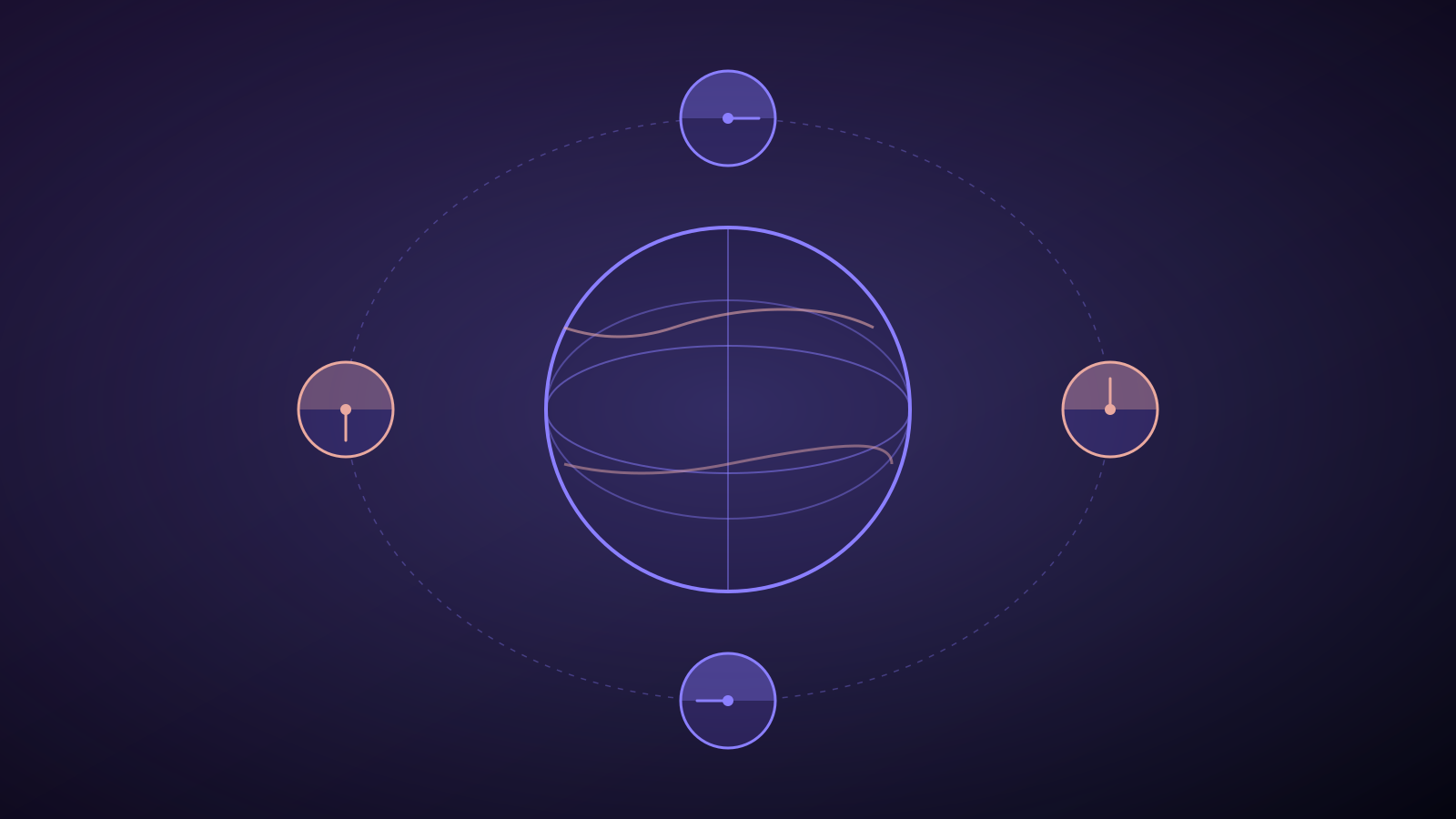
Most new lo-fi channels launch with a shuffled playlist and a single mood that runs 24 hours a day. Most of them also plateau. The difference between the top 100 lo-fi channels and the next 10,000 is not music quality — it’s that the top 100 treat the stream as programmed radio, with day parts, mood rotations, and time-zone-aware scheduling, while the rest treat it as background.
This is the full scheduling playbook. How to build a rotation, how to tune it to a global audience, and why this is the highest-leverage scheduling decision a lo-fi operator makes.
Why rotations matter at all
Three reasons, each independent:
- The audience is global, not local. “Lofi hip hop radio” searches peak at every hour of the day across different time zones. At 3am in Lagos, 9am in Tokyo, and 10pm in Chicago, different viewers are tuning in wanting different things. A shuffled playlist serves none of them well.
- The algorithm rewards structure. YouTube’s live-content resurfacing engine explicitly uses session length as a primary signal. Session length is highest when the listener encounters the stream at a moment where the mood matches their situation — which is the entire point of a rotation.
- Community ritual compounds. Regulars come back for specific blocks. “Night study” viewers are a different community from “morning chill” viewers, even when they’re on the same channel. Rotations give each community its moment.
A channel without mood rotations is a channel without day parts. A channel without day parts is a channel the audience can replace with any other channel of the same genre.
The day-part framework
The same framework that built commercial radio in the 20th century maps almost perfectly to 24/7 lo-fi. Here’s the translation.
The six day parts
- Early morning (04:00–08:00 local). Waking up, slow start, coffee. Music is warm, gentle, unobtrusive. Audience is small but extremely loyal; skew older, skew calm.
- Morning focus (08:00–12:00 local). Getting to work, getting through the first chunk of the day. Music is brighter, more rhythmic, still instrumental. Audience is the largest of the day in most markets.
- Afternoon study (12:00–16:00 local). Deep focus, reading, studying, writing. Music is slower than morning focus, with more ambient texture. This block retains the longest sessions.
- Evening wind-down (16:00–20:00 local). Transition out of work and into home. Music is warmer, more emotional, sometimes with gentle vocals. Audience is mixed.
- Night chill (20:00–00:00 local). Evening relaxation, not yet sleep. Music is downtempo with nostalgic tones. This is the second-largest block by audience in most markets and it converts best for merch and Patreon.
- Late night / sleep (00:00–04:00 local). Background for sleep. Music is ambient, minimal percussion, long fade-ins and fade-outs. Highest retention of any block, lowest active engagement.
Six blocks, four hours each, covering a full local day. The rotation itself is the same across time zones — what changes is whose local day it maps to right now.
The time-zone problem
You serve a global audience. Your broadcast is a single linear stream. Some of your viewers are at “morning focus” while others are at “late-night sleep.” You cannot broadcast six day parts to six regions simultaneously.
There are three workable strategies. Pick one and commit.
Strategy A — prime-zone rotation
Pick one target region (e.g. UTC+0, or your own region, or the largest audience region revealed by early analytics) and run the rotation as if the stream were local to that region. Other regions get their day parts at the “wrong” local time — morning focus at 2am, night chill at noon — and the channel becomes a “foreign station” for them.
This is the simplest strategy and the one most top channels use. Its strength is clarity: the channel has an opinion about whose day it is running. Its weakness is that the other regions under-convert.
Strategy B — drifting rotation
Run the 6 blocks faster than 24 hours. A full rotation every 18 or 20 hours, sliding the blocks across the clock over a week. Every region gets “morning focus” at their morning roughly once per week.
Pros: every region is served fairly. Cons: regulars can’t build a ritual around a specific time because the time drifts. This strategy works for larger channels that can afford to sacrifice ritual for reach; it hurts smaller channels that need ritual for community.
Strategy C — compressed rotation
Run all 6 day parts twice in 24 hours — two full rotations, each 12 hours. This serves two prime zones well (eastern and western hemisphere) and medium-well across the middle. It’s the strategy that works best for channels with a bi-continental audience (the US + Europe combination, or Japan + Europe).
Pros: two audiences served well. Cons: each block is only 2 hours instead of 4, which feels rushed, and the compression means transitions happen twice as often.
Recommendation: Start with Strategy A. Move to C once your analytics show at least two major audience regions. Strategy B is a specialty move for channels with a very broad global audience that is primarily drive-by rather than community.
Designing the music inside each block
Each day part is not just a mood — it’s a set of sub-parameters that the music curation has to hit. A good rotation isn’t “slower music at night.” It’s a specific sonic profile per block.
| Block | Tempo | Rhythm complexity | Texture | Vocals | Duration per track |
|---|---|---|---|---|---|
| Early morning | 70–85 BPM | Low | Warm, mellow | None | 2.5–4 min |
| Morning focus | 85–100 BPM | Medium | Clean, rhythmic | Rare, instrumental | 2.5–4 min |
| Afternoon study | 75–90 BPM | Medium-low | Layered, textured | Rare | 3–5 min |
| Evening wind-down | 70–85 BPM | Medium | Warm, nostalgic | Occasional, gentle | 3–5 min |
| Night chill | 65–80 BPM | Low | Spacious, emotional | Occasional, gentle | 3–6 min |
| Late night / sleep | 55–70 BPM | Minimal | Ambient, spacious | None | 4–8 min |
These are starting points, not rules. The important thing is that each block has a different profile, and a viewer who comes back to the same block twice finds the same emotional palette the second time.
The transitions between blocks
The hand-off from one block to another is the moment where casual listeners decide whether to stay. Two approaches work; one fails.
Approach 1 — soft fade
Three tracks at the tail of the outgoing block gradually shift toward the incoming block’s profile. Tempo slows by 5 BPM per track. Texture warms. By the time the block officially changes, the listener has already been eased in.
This is the approach that retains best. It also takes the most curation work, because you need dedicated “transition tracks” for every adjacency pair.
Approach 2 — hard cut with signpost
A clean break at the top of the hour, with a brief visual or audio signpost: a new overlay tag (“Night Chill begins now”), a title change, or a single bumper track that signals the shift.
Less work to set up, and some audiences actively prefer it — the explicit change gives them a ritual moment. It retains slightly worse than the soft fade but is a reasonable choice for smaller channels.
What fails
Transitioning without any signal and without a fade. The listener’s session is happily absorbing night chill, then without warning a morning focus beat kicks in and the session ends. Measurably worse retention every time.
The calendar layer — weekly and monthly specials
Rotations should be stable, but not static. Stable enough that a viewer can build a ritual; flexible enough that regulars have a reason to come back for a specific day.
Weekly specials
- Sunday: “Slow Sunday” — tempo reduced by 5 BPM across every block, more emotional vocals allowed, extended late-night block. Feels like a weekend variant.
- Wednesday: “Mid-week Focus” — morning focus and afternoon study blocks lean harder into productivity-coded music. Useful as a weekly “come back on Wednesday for the good study beats” hook.
- Friday night: “Weekend Warmup” — the night chill block extends an extra hour with warmer vocals and dance-adjacent undertones. A ritual for the regulars who come in after work on Friday.
Monthly specials
- New release block. Once a month, a 2-hour block dedicated to the month’s new additions to the library. Gives regulars a reason to tune in on a specific date and gives you something to promote on social media.
- Guest curator block. Collaborate with an artist or adjacent creator to curate a block once a month. Cross-audience exposure, community moment, and a measurable spike on that day.
- Season transition. Every 3 months, a visible seasonal shift — palette, mood, maybe visual variants — that signals the channel is alive and evolving.
The calendar layer is optional. A channel without it can still grow. A channel with it grows more predictably and gets better community retention.
How this shows up on screen
Mood rotations only work if viewers know which block they are in. Use clear visual cues in the source video to make each block recognizable.
- A small “Night Chill” or “Morning Focus” tag in the top or corner zone.
- A subtle palette shift in the overlay accent colour for different blocks.
- The visual loop itself can have block-specific variants — a brighter variant for morning focus, a darker variant for late night — though this is an optional polish rather than a requirement.
Communicate the block, don’t shout it. A small persistent tag beats a big splash.
Measurement — which block is actually working
A 24/7 lo-fi channel with mood rotations produces more interesting analytics than one without them. Specifically, you can now measure which block retains the best, which converts the best, and which pulls the most new viewers. That tells you what to double down on.
Weekly, check:
- Retention per block. Which block has the longest average session?
- New-viewer entry per block. Which block brings in the most first-time visits?
- Subscribe rate per block. Which block converts impressions to subs at the highest rate?
- Super Chat / Patreon signup rate per block. Which block monetizes best?
These rarely all agree. Night chill usually wins retention. Morning focus usually wins new viewers. Evening wind-down usually wins monetization. A serious operator uses this data to reinforce what’s working and to quietly retire the blocks that aren’t.
The pillar connection
Mood rotations are one of the five building blocks from the 24/7 lo-fi stream guide — specifically the “schedule” layer. The other four (library, visuals, pipeline, monetization) all get easier once the schedule layer is stable. If the rotation isn’t working, nothing else downstream will compensate.
Adjacent: the nature 24/7 pillar uses the same day-part framework with different music profiles. A nature stream’s “late night” block is closer to “pure rain” while its “morning focus” block is closer to “bright birdsong,” but the scheduling logic is the same. Operators who run both a lo-fi and a nature channel can share scheduling infrastructure across both.
What next
- How to Grow a Lo-fi Channel From 0 Subscribers — the 90-day plan that uses mood rotations as one of its highest-leverage tactics.
- How to Start a 24/7 Lo-fi Music Stream — the pillar hub that places scheduling inside the wider playbook.
- How to Run a 24/7 Nature Stream — the same framework applied to a different genre and a slightly different audience.
Once you have a finished video loop for a mood block, start a Streaminal free trial — upload the video and keep it streaming without leaving your laptop awake.